

Drink Spiking Symptoms & Test Kits: How SipSafe Detects GHB
Clinically reviewed & updated October 2026
Researched & Written by: U-Test Health Content Team
Updated: October 2026 · Evidence-Based | Aligned with NHS & NICE Clinical Frameworks
Editorial standard: This guide was developed using peer-reviewed UK medical evidence, NHS guidance, and NICE diagnostic frameworks. Self-testing kits from U-Test (UTest) provide rapid screening markers and do not replace formal clinical diagnosis or emergency medical care.
Drink Spiking Symptoms & Detection: Quick Summary
Drink spiking occurs when alcohol or drugs are added to someone's drink without their knowledge or consent. Common symptoms appear rapidly—often within 15 to 30 minutes—and include sudden severe intoxication out of proportion to alcohol consumed, loss of motor balance, slurred speech, visual disturbances, confusion, nausea, and memory blackouts. The most frequently detected substances alongside excess alcohol are GHB/GBL, Ketamine, and Benzodiazepines (such as Rohypnol). Discreet chemical spot-test stickers (like SipSafe) allow users to test a droplet of their drink, revealing the presence of GHB and Ketamine via a distinct color change in 1 to 3 minutes.
A night out with friends should be enjoyable and safe. However, drink spiking remains a major concern across UK universities, festivals, pubs, and clubs. Knowing the physiological symptoms of being spiked, understanding how date-rape drugs behave, and knowing how to test drinks discreetly can protect you and those around you.
At U-Test (UTest), we engineered SipSafe—our award-winning drink spiking detection stickers—to put immediate personal protection in your pocket. Below is our comprehensive UK safety and medical guide to drink spiking substances, warning signs, testing technology, and emergency next steps.
The Most Common Spiking Substances in the UK
While alcohol remains the most common substance secretly added to drinks (e.g. adding double measures without telling someone), drug-facilitated sexual assault (DFSA) and theft frequently involve central nervous system depressants:
- 1. GHB (Gamma-Hydroxybutyrate) & GBL (Gamma-Butyrolactone): A potent central nervous system depressant. GHB is usually a colourless, odourless liquid, sometimes with a faint salty or soapy taste. It causes intense drowsiness, loss of inhibitions, amnesia, and can induce coma within 20 minutes when combined with alcohol.
- 2. Ketamine: A dissociative anaesthetic. It induces a feeling of detachment from reality ("out-of-body" sensation), hallucinations, immobility, and profound numbness.
- 3. Benzodiazepines (Rohypnol / Flunitrazepam, Diazepam, Alprazolam): Powerful prescription sedatives and muscle relaxants. They cause anterograde amnesia (inability to form new memories while under the drug's influence) and extreme grogginess.
Clinical Table: Spiking Drugs, Onset Times & Effects
Medical and forensic data outline the following pharmacokinetic profiles:
| Substance | Onset Window | Taste / Smell Clues | Physical & Mental Effects | Body Elimination Half-Life |
|---|---|---|---|---|
| GHB / GBL | 10 – 25 minutes | Slightly salty, chemical, or imperceptible | Dizziness, slurred speech, confusion, sudden sleep, respiratory depression. | Fast: cleared from urine in 10–12 hours, blood in 4–6 hours. |
| Ketamine | 10 – 20 minutes | Bitter chemical taste (often masked by sweet cocktails) | Dissociation, paralysis ("k-hole"), loss of coordination, auditory distortion. | Cleared from urine within 24–48 hours. |
| Rohypnol / Benzodiazepines | 20 – 30 minutes | Usually flavourless | Extreme sedation, anterograde memory blackout, unsteadiness, slowed reflexes. | Detected in urine for 48–96 hours. |
| Extra Spirits / Alcohol | 15 – 30 minutes | Stronger alcohol flavour | Slurred speech, disinhibition, vomiting, loss of motor control. | Metabolised at roughly 1 unit per hour. |
Physical & Cognitive Warning Signs You Have Been Spiked
Because many victims have consumed alcohol, recognizing the boundary between "having a few drinks" and "being drugged" is critical:
- Feeling Disproportionately Drunk: You have only had one or two drinks, yet your limbs feel heavy and you can barely walk or form coherent sentences.
- Visual and Auditory Distortion: The room appears spinning, tunnel vision develops, or sound feels distant and muffled.
- Sudden Nausea & Cold Sweats: Overwhelming nausea without heavy alcohol intake.
- Cognitive Disconnection: Inability to remember who you arrived with or losing track of time in brief gaps.
Test Your Drink in 1 Minute: SipSafe Spiking Test Stickers
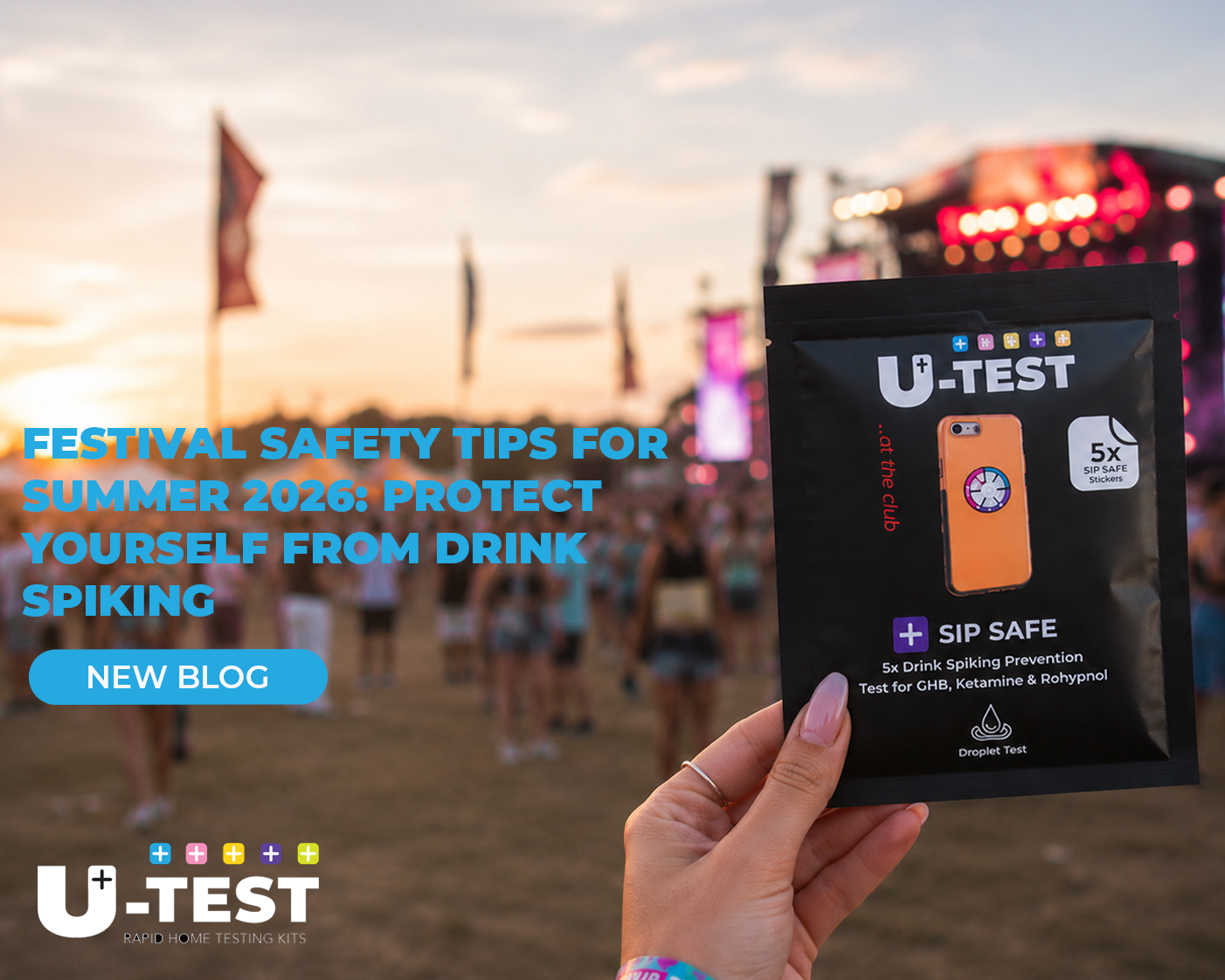
Stay protected on nights out, at university, and at festivals. SipSafe by U-Test is a discreet, wallet-sized pack of 5 stickers that rapidly detects GHB and Ketamine from a single drop of liquid.
Easy to stick to your wrist, glass, or phone case. Results show in 1–3 minutes.
How SipSafe Drink Spiking Test Stickers Work
SipSafe uses proprietary colorimetric chemical spot-testing technology built onto discreet adhesive stickers:
- Apply a drop: Place a drop of your drink onto test spot 1 and test spot 2 using a straw or the tip of your finger.
- Wait 1 to 3 minutes: Allow the reagent pads to react with the liquid.
- Check for colour shift:
- Spot 1 (GHB Test): Turns blue if GHB is present.
- Spot 2 (Ketamine Test): Turns pink/red if Ketamine is present.
Vital Safety Warning: While SipSafe detects GHB and Ketamine with high specificity, no test sticker screens for every chemical compound or extra alcohol. If your test is negative, but your drink looks cloudy, tastes odd, or you left it unattended, never drink it. Trust your instincts.
Emergency Action Plan: What to Do If You or a Friend Is Spiked
If you suspect someone has had their drink spiked, take immediate, decisive action:
- 1. Alert venue staff immediately: Tell bar staff or bouncers. In the UK, most licensed venues operate the "Ask for Angela" safety scheme, where staff are trained to discreetly assist you to a safe space or hail a licensed taxi.
- 2. Never leave the person alone: Stay with your friend. Ensure they are not separated or led away by someone they do not know well.
- 3. Preserve the drink: If safe to do so, cover the drink or hand it to venue management. Police can use the remaining liquid for forensic toxicology testing.
- 4. Call 999 or attend A&E: If the person loses consciousness, is breathing shallowly, or cannot respond, treat this as a medical emergency.
- 5. Seek early medical testing: Drugs like GHB leave the body via urine within 10–12 hours. If reporting to police, prompt clinical toxicology samples taken within 24 hours are vital for evidence.
Frequently Asked Questions About Drink Spiking
Can drink spiking drugs be tasted?
Frequently, no. GHB can have a subtle salty taste, and Ketamine is bitter, but in strong alcoholic drinks, mixers, or sugary festival cocktails, the flavour is easily completely masked.
Do drink spiking test strips really work?
Yes. Chemical spot tests like SipSafe react reliably to specific chemical functional groups present in GHB and Ketamine, producing a distinct color change in seconds. They are a proven deterrent and rapid safety screen.
Is drink spiking illegal in the UK?
Yes. Spiking someone's drink is a serious criminal offence under the Offences Against the Person Act 1861 and the Sexual Offences Act 2003, carrying sentences of up to 10 years in prison.


