

Prostate cancer screening: what Parliament's debate means for UK men
 Related home test
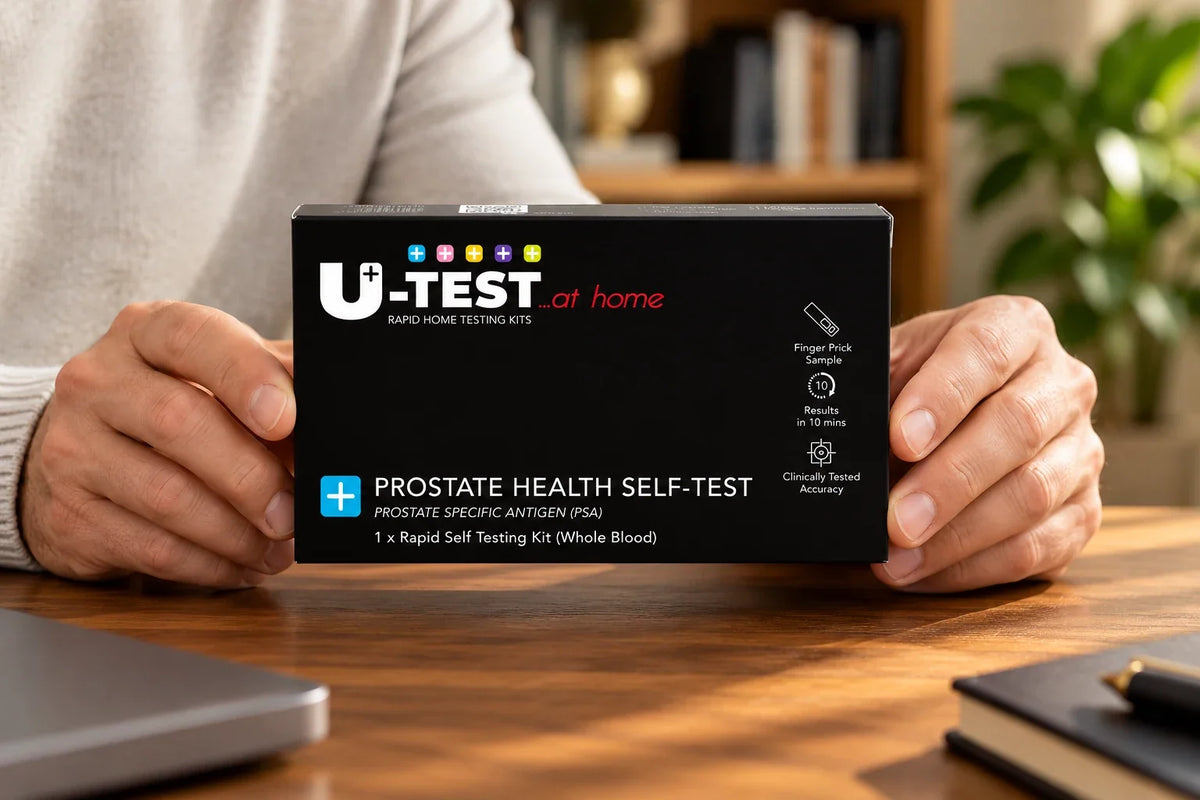
Prostate PSA Test Kit
An initial indication of PSA from a finger-prick sample, in 10 minutes.
See the test
Key takeaways
- On 26 October 2026 MPs debated a 101,932-signature petition asking for prostate cancer screening for all higher-risk men.
- From 2027 the NHS will screen only men aged 45 to 61 with a BRCA2 gene variant and a family history, a few thousand men a year.
- Stage matters: in England about 92% of men diagnosed at stage 1 or 2 are alive five years later, against 60% at stage 4.
- Any man can still ask his GP about a PSA test. Knowing your risk and acting on it is the best tool men have right now.
On Monday 26 October 2026, MPs gathered in Westminster Hall to debate prostate cancer screening. The debate was triggered by a public petition that gathered 101,932 signatures, asking the government to screen all men at higher risk of the disease, not just a small genetic group. Clips of the debate have been all over the news and social media since.
So what was said, what has actually changed, and what can you do about it today? Here are the facts, the numbers and the options, in plain English.
What happened in Parliament
The 90-minute debate on e-petition 751472 was opened by John Lamont MP on behalf of the Petitions Committee, with Dr Andrew Murrison in the chair. MPs from across the parties spoke, including Ben Obese-Jecty (Conservative, Huntingdon), Perran Moon (Independent, Camborne and Redruth), Dr Luke Evans (Conservative, Hinckley and Bosworth), Rishi Sunak and David Chadwick (Liberal Democrat, Brecon, Radnor and Cwm Tawe), who shared the story of a constituent diagnosed with incurable prostate cancer at 56 after it was found by chance.
The petition asked the government to look again at the UK National Screening Committee's advice and to introduce screening for all higher-risk men, including Black men and men with a family history. Responding for the government, health minister Dame Diana Johnson said the priority was finding cancers earlier without exposing men to treatment for cancers that may never harm them, and confirmed that men can still ask their GP for a PSA test after talking through the pros and cons. Westminster Hall debates don't end in a vote, so the debate itself doesn't change the policy, but it puts the pressure on.
Where prostate cancer screening stands now
The UK National Screening Committee (UK NSC) advises all four UK nations on screening. Its final recommendation, published on 28 May 2026, was a targeted programme only: PSA testing every two years for men aged 45 to 61 who carry a BRCA2 gene variant and have a family history of breast, ovarian, pancreatic or prostate cancer. The government accepted it in June 2026, and screening for this group starts in 2027.
That group is small. The committee estimated it would mean a few thousand men screened each year, and campaigners put the eligible group at around 1,500 men. The committee advised against screening all men, and against screening other higher-risk groups such as Black men, saying the current evidence doesn't yet show the benefits would outweigh the harms of over-diagnosis and over-treatment. Its earlier draft had also included BRCA1 carriers; the final version dropped them.
Charities including Prostate Cancer UK, Prostate Cancer Research and Cancer Research UK said they were disappointed. The committee's chair said he hoped new evidence and better tests would support wider screening in future.
The PSA guidance change in August
In August 2026 the Department of Health and Social Care withdrew the Prostate Cancer Risk Management Programme guidance. Since 2002, that guidance had said the PSA test was available free to any man aged 50 or over who asked for it, after a balanced conversation with his GP.
GPs are now pointed to NICE guidance instead, which looks at each man's individual risk rather than age alone. Critics said this takes away a right men relied on. The department said the policy hasn't changed: every man can still ask his GP for a PSA test, and the final decision has always rested with the GP. Our prostate health guide covers PSA testing in more detail.
Prostate cancer in the UK: the numbers
| Fact | Figure | Source |
|---|---|---|
| Men diagnosed each year (UK) | More than 64,000 | Prostate Cancer UK |
| Men who die from it each year (UK) | More than 12,000, around 33 a day | Prostate Cancer UK; Cancer Research UK |
| Rank among cancer deaths in men | 2nd most common cause of cancer death in men | Cancer Research UK |
| Lifetime risk | 1 in 8 men; 1 in 4 Black men | Prostate Cancer UK |
| Lifetime risk of dying from it | About 1 in 24 white men; 1 in 12 Black men | BMC Medicine study, Prostate Cancer UK |
| Father or brother had it | About two and a half times the risk | Prostate Cancer UK |
| Men living with or after prostate cancer | Around 540,000 | Prostate Cancer UK |
| All cancer deaths in UK men | Almost 90,000 a year | World Cancer Research Fund (UK figures) |
Prostate cancer is now the most commonly diagnosed cancer in the UK, and the most common cancer with no national screening programme for most men.
Early or late: why the stage matters so much
Prostate cancer is staged from 1 to 4. Stages 1 and 2 are still inside the prostate. Stage 3 has started to break out of it. Stage 4 has spread, often to the bones, and can be treated and controlled but not usually cured.
| Stage at diagnosis | Alive 5 years later (England) |
|---|---|
| Stage 1 | Almost 100% |
| Stage 2 | Around 95% |
| Stages 1 and 2 together | Around 92% |
| Stage 4 | Around 50 to 60% |
Sources: Cancer Research UK (stage 1, 2 and 4, men diagnosed 2013 to 2017) and NHS England data via the House of Lords Library (stages 1–2 together, and stage 4 at 60%).
How many are caught early, and how many late? In England in 2022, 53% of prostate cancers were diagnosed at stage 1 or 2, and 47% at stage 3 or 4. Around 1 in 8 men (12%) in England were diagnosed after the cancer had already spread, and in Wales it was 1 in 5 (20%). Prostate Cancer UK has estimated that almost 10,000 men a year across the UK are diagnosed at stage 4.
Where you live matters too. Prostate Cancer UK's analysis found that around 1 in 8 men with prostate cancer in London were diagnosed once it had spread, compared with more than 1 in 3 in Scotland. Men in more deprived areas are also more likely to be diagnosed late.
Does testing early actually save lives?
The biggest trial on this, the European Randomised Study of Screening for Prostate Cancer (ERSPC), followed more than 160,000 men for 23 years. Its final results, published in the New England Journal of Medicine in October 2025, found that men offered regular PSA testing were 13% less likely to die from prostate cancer than men who weren't. One death was prevented for every 456 men invited, and for every 12 men diagnosed. The benefit grew the longer men were followed. The screened group also had fewer advanced cancers.
The same trial shows the other side of the argument: screening also finds many slow-growing cancers that may never have caused harm, and some men go on to have biopsies or treatment they didn't need. That trade-off is exactly what the UK NSC weighed up. A new UK trial, TRANSFORM, is now testing smarter ways to screen, combining PSA with fast MRI scans and genetic risk. Its first men were tested in March 2026, it aims to recruit up to 300,000 men, and it is being extended so that all eligible Black men are invited. Places are by GP invitation only.
The honest bit about the PSA test
PSA (prostate-specific antigen) is a protein made by the prostate. A raised level can be a sign of prostate cancer, but also of an enlarged prostate, an infection, recent ejaculation or hard exercise. According to NHS figures, around 3 in 4 men with a raised PSA don't have cancer, and around 1 in 7 men with prostate cancer have a normal PSA.
That's why a PSA result is a starting point, not an answer. It is still the first test the NHS uses, and for many men it's what starts the conversation that leads to an early diagnosis.
What you can do now
You don't need to wait for a screening invitation. Here's how to be proactive:
- Know your risk. Your risk is higher if you're over 50, Black (from 45), or your father or brother had prostate cancer. A family history of breast or ovarian cancer, or a known BRCA gene variant, also counts.
- Talk to your GP. Any man can ask about a PSA test, with or without symptoms. Go in knowing your risk factors and ask for a numbered lab result.
- Don't ignore symptoms. Peeing more often, getting up at night to pee, a weak flow, needing to rush or blood in your pee or semen should all be checked by a GP, whatever any earlier test said.
- Check, then check again. PSA changes over time, so one result isn't for life. See how often should you test at home?
Where a home PSA test fits in
Getting a GP appointment can take time. CQC figures show that around 5 million people a month in England waited more than two weeks for a GP appointment, and around 1.4 million waited more than four weeks (March 2024). A home check lets you take a first step today, without waiting just to find out whether you need an appointment.
The U-Test Prostate PSA Test Kit is a finger-prick screen that gives an indication in about 10 minutes. A clear result is reassurance for now. A raised result means you book your GP knowing exactly why you're going, and they can arrange a lab PSA blood test, which gives a precise number and starts the right NHS pathway.
Be clear about what it is: a home kit gives a threshold reading, not a number, and it can't tell you whether cancer is present. In 2025 the MHRA said over-the-counter PSA kits are not a reliable indicator of prostate cancer, and Prostate Cancer UK recommends a lab test through your GP. Use a home check as a prompt to act, never as a reason to skip your GP.
Other male cancers worth checking for
- Testicular cancer is the most common cancer in younger men, with around 2,300 cases a year in the UK. When found early it's one of the most curable cancers: around 96% of men survive 10 years or more. Learn how to check your testicles.
- Bowel cancer: the NHS sends a free bowel screening kit every 2 years to everyone aged 50 to 74. Always do it.
- The NHS Health Check is offered every 5 years to adults aged 40 to 74 in England.
Our men's health checks guide brings these together in one routine.
When to see a GP, call 111 or 999
See a GP about any urinary symptoms, a raised PSA result, or a lump or change in a testicle. Call 111 if you can't pee, or have blood in your pee and feel unwell. Call 999 if you're in severe pain and can't pee at all, or in any emergency.
Common questions
Can I still get a PSA test on the NHS?
Yes. Any man can ask his GP about a PSA test. Since August 2026 the GP looks at your individual risk before deciding, so go in knowing your age, ethnicity and family history.
Who will be screened from 2027?
Men aged 45 to 61 with a BRCA2 gene variant and a family history of breast, ovarian, pancreatic or prostate cancer, invited every two years.
Why isn't there screening for all men?
The UK NSC concluded that PSA screening for all men would find many cancers that would never cause harm and lead to unnecessary treatment, and that the evidence doesn't yet show the benefits outweigh those harms. Trials such as TRANSFORM are designed to answer that.
Does a normal PSA mean I'm clear?
Not completely. Around 1 in 7 men with prostate cancer have a normal PSA, so see your GP about any symptoms whatever your result.
Can a home test replace my GP?
No. It's a quick first check. A raised result, or any symptoms, should always go to your GP for a lab test.
This article is general information and does not replace individual medical advice.
Sources
Checked 6 November 2026
- House of Commons Library: Prostate cancer screening (CBP-12230, 20 Oct 2026)
- UK Parliament: Westminster Hall, e-petition 751472, 26 Oct 2026
- UK National Screening Committee: prostate cancer recommendation
- Prostate Cancer Research: UK NSC confirmed recommendation (28 May 2026)
- Pulse: DHSC sets out updated guidance on PSA testing (21 Aug 2026)
- GOV.UK: PCRMP PSA test benefits and risks (withdrawn)
- Prostate Cancer UK: facts and figures
- Cancer Research UK: prostate cancer mortality statistics
- Cancer Research UK: survival for prostate cancer
- House of Lords Library: Prostate cancer, tests for men at the highest risk
- National Prostate Cancer Audit: State of the Nation 2025
- Prostate Cancer UK: North-South divide in diagnoses
- NEJM: European Study of Prostate Cancer Screening, 23-year follow-up (2025)
- Prostate Cancer UK: first men tested in TRANSFORM (Mar 2026)
- Imperial College London: TRANSFORM extended to Black men
- NHS: PSA test
- BBC News: Warning over rapid at-home prostate tests (2025)
- Cancer Research UK: testicular cancer statistics
- World Cancer Research Fund: UK cancer statistics
- CQC: State of Care, GP access
- NHS: Bowel cancer screening
Check at home
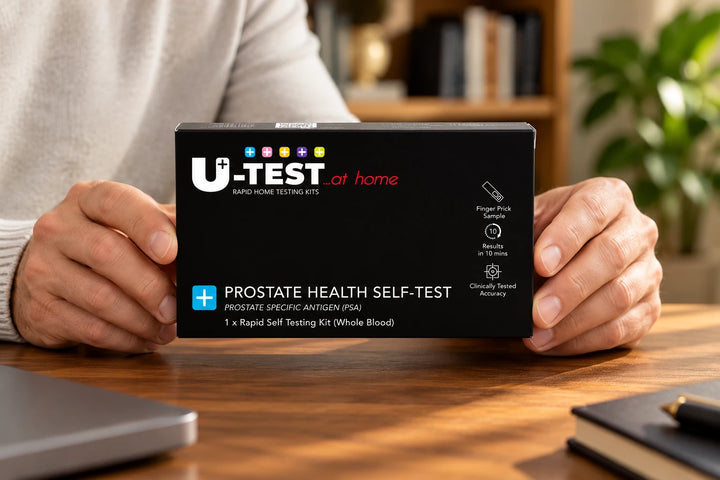
Prostate PSA Test Kit
- Gives an initial indication of PSA
- Result in 10 minutes
- Finger-prick sample, done at home
Free delivery over £25 · Discreet packaging
See the test

